Vector VFlash vs MyCANIC FScript
Which ECU programming tool actually fits your operation?
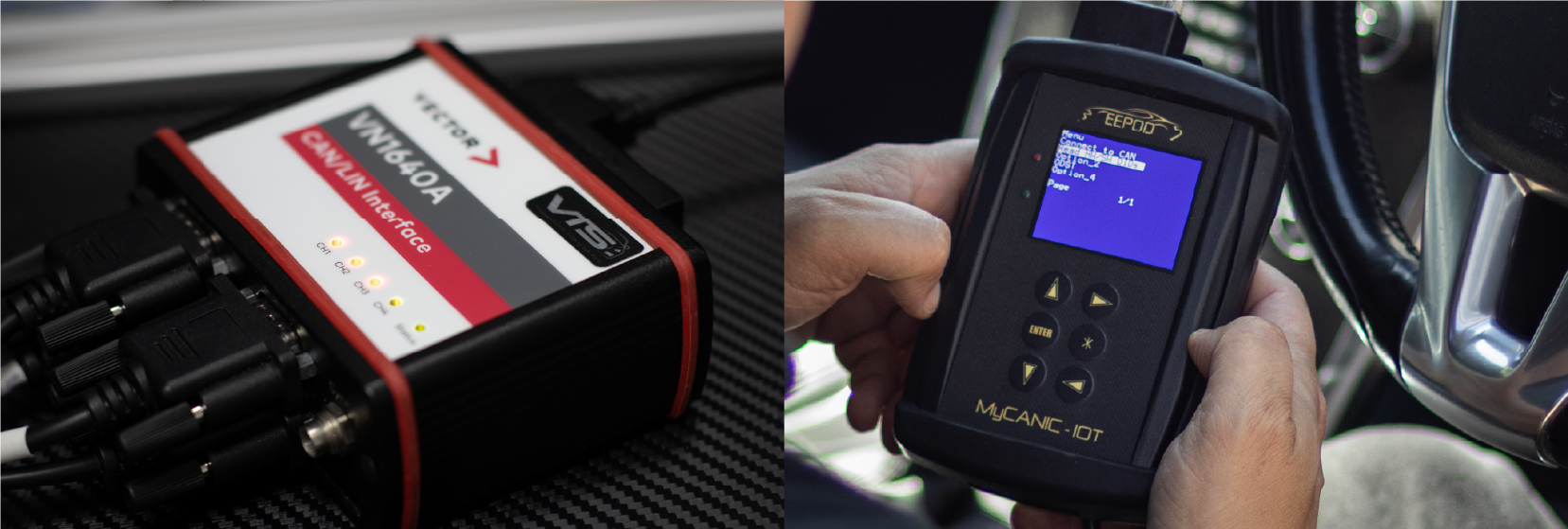
Two tools, two very different worlds
If you've spent any time looking at ECU programming tools, you've probably come across two names that keep showing up. Vector VFlash is the industry heavyweight, backed by a German company with 35+ years in automotive electronics. MyCANIC FScript, made by EEPod LLC out of Arizona, is the scrappy challenger that's been quietly building a following among OEMs and Tier 1 suppliers since 2007.
They both program ECUs. They both talk CAN, CAN FD, and Ethernet. But that's roughly where the similarities end. Comparing them is a bit like comparing a fully equipped workshop with a portable toolkit... both will get the job done, but the right choice depends entirely on where you're working and what you're trying to achieve.
This comparison strips away the marketing fluff and lays out exactly what each tool does, what it costs, and who it's actually built for. If you're a fleet manager weighing up options, an operations lead planning a recall programme, or an engineering team looking for a faster way to handle ECU updates in the field, this is the article you need.
Vector VFlash: the enterprise standard
Vector Informatik GmbH is headquartered in Stuttgart. They make software tools used by almost every major car manufacturer on the planet, and VFlash is their ECU flashing product. It's PC-based software designed primarily for use in labs, production lines, and test benches.
What does VFlash actually do?
VFlash programs ECUs using diagnostic protocols like UDS (Unified Diagnostic Services). It works across CAN, CAN FD, LIN, FlexRay, and Ethernet (including DoIP). The software supports over 290 different flash specifications from more than 140 vehicle manufacturers straight out of the box, thanks to a plugin system Vector calls "templates." Each template mirrors a specific OEM's bootloader sequence, so engineers don't need to build flash routines from scratch.
There are two main variants. VFlash Standard handles one ECU at a time through a single communication channel. VFlash Station is the bigger brother, capable of flashing up to 10 ECUs simultaneously on separate channels. Both come in Desktop Editions (with a graphical interface for manual operation) and Test Bench Editions (with C and C# APIs for automated production integration).
Vector also offers VFlash Compact, which runs on their standalone VN8810 hardware device. This is their answer to portable field use... though it still requires a PC to configure flash packages before you can deploy them to the device.
Who uses VFlash?
VFlash is built for OEMs and large Tier 1 suppliers. Volkswagen uses it at their Emden plant for just-in-time ECU updates on the production line. Valeo uses it for end-of-line programming of LED matrix headlights across multiple OEM projects. It's a tool for environments where you're flashing thousands of ECUs per day, where integration with HIL (Hardware-in-the-Loop) test systems and CI/CT pipelines matters, and where IT departments manage complex license structures.
What does VFlash cost?
Vector doesn't publish prices. Every enquiry gets a "contact sales" response. What we do know is this: VFlash requires a separate hardware interface to communicate with vehicles. The most common is the VN1630A, a USB-to-CAN/LIN adapter. New units sell for roughly $2,000 to $5,000 USD depending on the supplier and configuration. The standalone VN8810 diagnostic device costs significantly more.
On top of the hardware, you need the VFlash software licence. Vector uses device-locked, user-locked, and test-bench-locked licence types. The VFlash Station requires a separate licence from VFlash Standard. Custom OEM security add-ons (for seed/key authentication) are additional purchases. Annual maintenance contracts keep you on supported versions.
Nobody outside of Vector's sales team can give you an exact figure, but industry conversations consistently put a basic VFlash setup (hardware + software + one template) in the range of $5,000 to $15,000+ USD. Production-line deployments with VFlash Station and multiple channels climb well beyond that. This isn't a criticism... it reflects the enterprise market Vector operates in.
MyCANIC FScript: the portable workhorse
EEPod LLC started building MyCANIC tools in 2007. The original device was a handheld CAN interface with a gold keypad. In 2018, the MyCANIC-FD added CAN FD, LIN, and Ethernet support. The latest version, MyCANIC-IOT, brings wireless cloud connectivity into the mix alongside everything the FD could do.
FScript is the scripting language that runs on these devices. It's a licence-activated compiler that turns plain text script files into encrypted binaries (.FSF files) stored on the device's SD card. The MyCANIC-IOT then executes those scripts completely standalone, with no PC connected, no laptop balanced on the bonnet, no Wi-Fi dependency during operation.
What does FScript actually do?
Everything VFlash does at the ECU level... just without the GUI and the massive OEM template library. FScript handles UDS diagnostic requests, VBF file programming (the same format used by many OEMs), security access with seed/key authentication, DTC reading and clearing, DID read/write operations, and CAN message send/receive. It also does things VFlash doesn't do natively: custom LCD displays for operator guidance, LED pass/fail indicators, automatic VIN verification, and data logging to CSV files on the SD card.
The scripting approach means engineers write sequences of commands in a text file. A sample script might initialise a CAN network, set up a diagnostic filter, read the VIN, check the current module part number, decide which firmware to flash based on that reading, program the new VBF files, verify the result, and log everything. That entire workflow compiles into a single encrypted .FSF file. Hand the MyCANIC to a technician, plug it into the OBD port, press Enter... done.
The MyCANIC-IOT hardware itself is compact. Two CAN/CAN FD channels, one LIN/K-Line interface, Ethernet with DoIP support, USB, a colour LCD, a 6-key keypad, green and red LEDs, and a 16GB SD card. It's J2534 pass-through compatible, so it can also serve as a standard vehicle interface when you need it to.
What does FScript cost?
This one's straightforward. The MyCANIC-IOT hardware is $995 USD (approximately £800). The FScript compiler licence is $1,295 USD. VTS sells the FScript licence at £1,184.65. Total cost for a complete, field-ready ECU programming setup: under £2,000. That includes the hardware, the compiler, a licence activation token, getting-started documentation, training videos, and two hours of support.
No annual licence fees. No hardware interface to buy separately. No "contact sales" pricing. The device IS the interface.
Head-to-head comparison
Here's where we line them up side by side. No spin. Just facts.
Learning curve and day-to-day usability
VFlash's graphical interface is genuinely well designed. You create a flash project from a template, point it at your firmware file, connect to the ECU, and click "Flash." For a single ECU update in a lab environment, it's hard to fault. The templates hide the complexity of OEM-specific bootloader sequences, so an engineer who's never flashed a particular module before can get it right on the first try. That said, once you move beyond basic flashing into Custom Actions (pre/post-flash sequences for data backup, encoding, or validation), you're writing VDS scripts or C/C# code. The learning curve steepens considerably.
FScript takes the opposite approach. There's no GUI. You're writing scripts in a text editor from day one. For someone who's never written a line of code, that sounds intimidating. In practice, FScript reads more like a set of instructions than traditional programming. A command like REQUEST 0x22 0xF1 0x88 is just asking the ECU for its part number using standard UDS service $22. The syntax is closer to a recipe than a software project. EEPod provides training videos, example scripts, and two hours of direct support with every licence. Most engineers we've spoken to are writing functional scripts within a day or two.
The bigger difference is what happens after the initial setup. With VFlash, every technician who uses the tool interacts with the PC software. They need some level of training on the interface, access to the right flash packages, and enough understanding to troubleshoot if something goes wrong. With FScript, the engineer builds the script once, and the technician's entire interaction is: plug in, select script, press Enter, wait for the green LED. You've moved the complexity from the field back to the engineering office, where it belongs.
Deployment at scale: 1 device vs 50
This is where the operational differences become stark. Suppose you need to deploy an ECU update across 50 workshop locations as part of a service campaign.
With VFlash, each location needs a Windows PC (meeting Vector's system requirements of at least an Intel 2GHz dual-core with 8GB RAM), a Vector hardware interface, a valid VFlash licence, the correct OEM template, and the flash package. Your IT team manages licence distribution, software updates, and hardware inventory. If a VN1630A fails at location 37, someone needs to ship a replacement and reconfigure it. Multiply the per-location cost by 50 and the numbers add up fast.
With MyCANIC FScript, each location gets a MyCANIC-IOT (roughly the size of a smartphone), an SD card with the compiled script and firmware files, and an OBD cable. That's it. If a device fails, you ship a replacement and slot in the same SD card. With the IoT cloud connectivity, you can push updated scripts to all 50 devices simultaneously without touching a single SD card. The total fleet cost for 50 MyCANIC-IOT units is roughly the same as equipping two or three VFlash stations.
Which tool fits which job?
The real question: what are you actually paying for?
Vector's pricing reflects a business model built around large enterprise contracts, annual maintenance fees, and an ecosystem of tools (CANoe, CANalyzer, Indigo) that all work together. For organisations already embedded in the Vector ecosystem, adding VFlash is a natural extension. The cost is absorbed across a massive operation.
For smaller operations, independent workshops, Tier 2 and Tier 3 suppliers, recall contractors, and field service teams, that pricing model doesn't work. You need a tool that does the job, fits in a bag, costs less than a used car, and doesn't require an IT department to manage.
That's the gap MyCANIC FScript fills. It's not trying to replace VFlash on the production line. It's giving operations that would never consider a $15,000+ toolchain a professional, repeatable, auditable way to program ECUs.
Honest limitations of each tool
Where VFlash falls short
Portability is the obvious one. VFlash is PC software. Even the standalone VN8810 option still needs a PC for setup and configuration. The pricing opacity is frustrating for smaller buyers who just want a number before committing time to a sales conversation. And the licence management system (device-locked licences, docking station compatibility issues, separate Station licences) adds administrative overhead that smaller teams don't need. Vector's own documentation even acknowledges that laptops used with and without docking stations may experience licence verification issues... which tells you something about the complexity of the system.
Where FScript falls short
No FlexRay support. If you're working with older BMW or Mercedes architectures that rely heavily on FlexRay, FScript isn't an option today. There's no pre-built template library, so every new ECU type requires script development by someone who understands the diagnostic protocol. The scripting language, while surprisingly readable, still requires engineering knowledge to write properly. You won't hand script development to a non-technical person.
The single-ECU-at-a-time limitation rules out high-volume parallel flashing. And while the FScript manual runs to 43 revisions (now at version 1.43 as of April 2025), which shows active development, the documentation is more reference guide than tutorial. It assumes you already know what a UDS service ID is. If you don't, you'll need support or training to get started.
The bottom line
These are two excellent tools built for fundamentally different operational contexts. Picking one over the other without considering your actual use case would be a mistake.
If your operation programmes thousands of ECUs per day on a factory floor, requires parallel flashing, and integrates with enterprise test automation... VFlash is the right answer. It's expensive because the problems it solves are expensive problems.
If you need portable, standalone ECU programming for field service, recall campaigns, bench testing, or any scenario where a technician needs to flash firmware without a laptop... MyCANIC FScript delivers at a fraction of the cost. For under £2,000, you get a complete, professional-grade toolchain that fits in your hand.
And honestly? Plenty of organisations use both. VFlash in the lab and on the production line, MyCANIC in the field. They're not competitors so much as they're colleagues solving different parts of the same problem.